Traders who think in words
You know the setup and the reason for it, but not how to code it. Describe it in your own words, by voice, or draw it on the chart. The AI asks only the questions that change the strategy.
AI-native strategy engineering
CTE Algo turns a trading idea into a precise, testable strategy. Say it in words, speak it, or draw it on a chart. It shows you exactly what it understood, checks what it can prove, and does nothing until you approve.
For traders, with or without code. Now in early access. It builds, checks and tests strategies; it does not place trades for you.
You said
“Buy gold when RSI drops below 30, stop 50 pips.”
registered tools a strategy is built from: indicators, price action, higher timeframes and cross-asset.
checks before you can approve, from look-ahead to dropped fills.
API routes that can send an order to a broker. A test over the API schema fails if one appears.
plain-language cases the AI layer is measured against on the live model.
The product
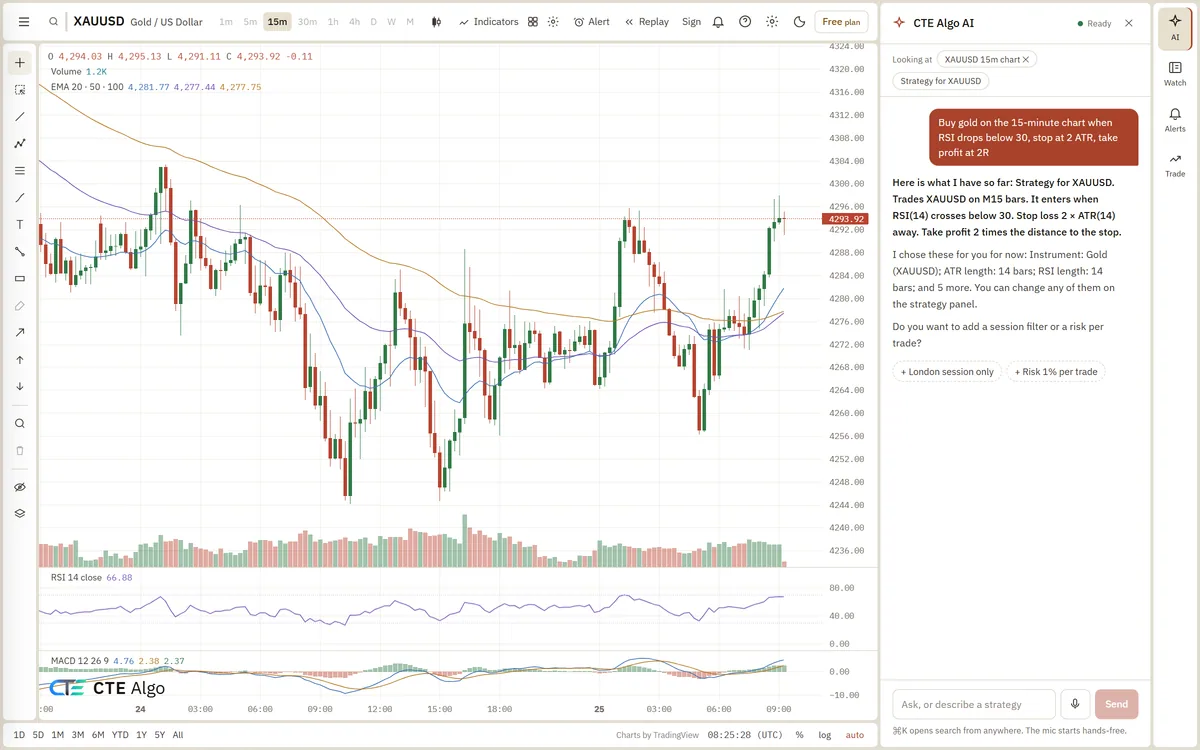
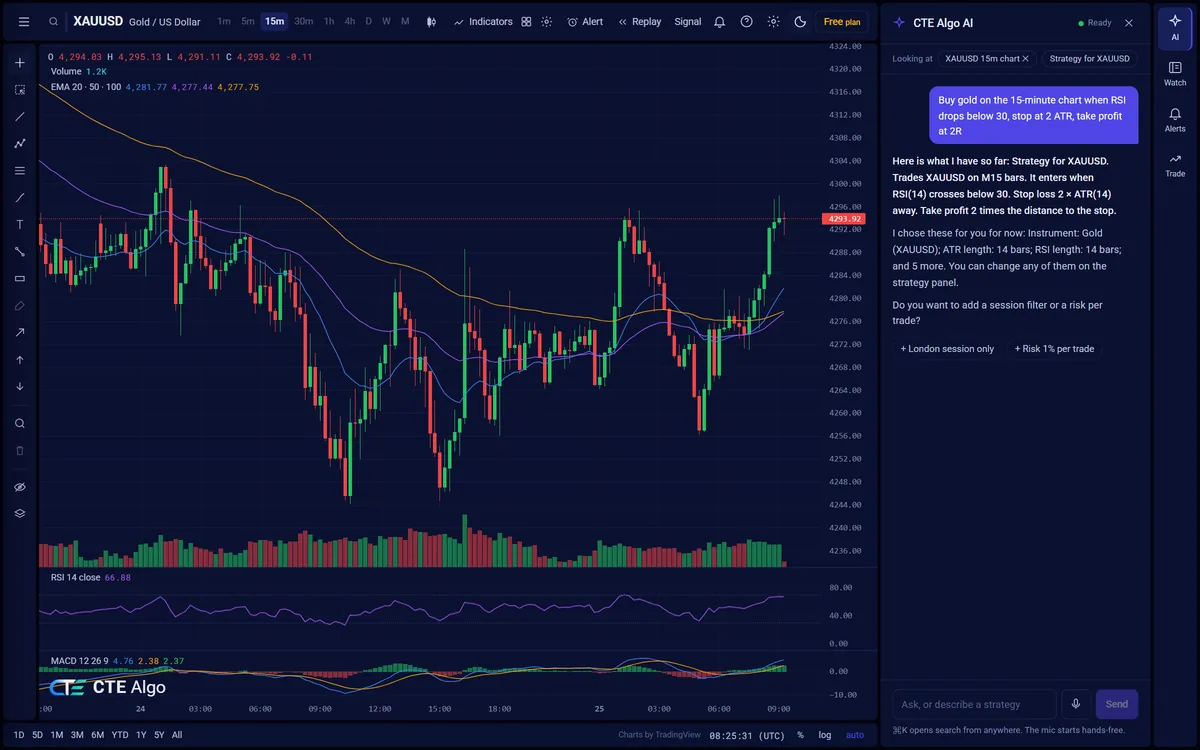
The chart, the indicators and the assistant share one screen. Describe the idea and the assistant restates it in plain words, lists every value it chose for you, and asks only what would change the strategy.
Who it is for
You know the setup and the reason for it, but not how to code it. Describe it in your own words, by voice, or draw it on the chart. The AI asks only the questions that change the strategy.
Market structure, order blocks, liquidity, supply and demand, retracements. They are tools in the registry, so your rules are built from calculated levels, not from a model's reading of a picture.
A test can look good because it peeked at the future. CTE Algo re-runs the strategy against different futures, moves every number by ten percent and stresses the spread before it lets you approve.
Not for personal investment advice. Ask whether you should buy something with your savings and CTE Algo declines and says why.
How it works
Type it, speak it or draw it on the chart. Plain words, your own vocabulary.
The AI writes down only what you said. A compiler turns that into a strategy and lists every gap it had to fill.
Eight kinds of check run, each giving the same answer for the same input. A check that could not run is reported as skipped, never as passed.
Nothing goes further without your explicit approval of the compiled strategy.
Backtest with spread and slippage, replay it bar by bar, and watch it on the chart.
Built with Claude
Reading what a trader meant is the one job that needs a language model, so that is the one job we give to Claude. It sorts the request and writes down only what you said. A compiler, validators and a risk engine take it from there, and none of them is a model.
Claude classifies the request, then proposes a structured strategy record through a schema-locked tool (a form it must fill in exactly). Anything you did not say stays empty.
The model sees a sentence and a schema. It has no account, no credentials and no path to either, by module boundary and by test.
A 39-case set measures the live model. Spend is capped per user, and the long system prompt is cached.
It is also how we build. Claude Code works as builder and critic on our own code, and our rule is that a person reviews a change before it merges.
Tell us what you trade and what you want to test. We reply as soon as we can.