Product

Strategy engineering, in plain words.

CTE Algo is an AI-native workspace for building, checking and testing trading strategies. The AI reads what you mean. Deterministic tools do every calculation. You approve before anything goes further. Today it sends alerts but does not place trades for you.

What it is

Most trading software asks you to learn its language. CTE Algo learns yours. A trader describes a strategy, or draws it on a chart, and the system turns it into a formal, versioned, executable specification that anyone can read back.

What we sell is comprehension: that the system understood the strategy correctly, can show it did not cheat, and will not quietly invent a rule you never asked for.

Who it is for

  • New to rules

    Traders who can say what they would do but cannot code it. No setup, no scripting.

  • Chart-first

    Traders who work from structure, zones and liquidity and want those ideas tested exactly.

  • Sceptical of tests

    Traders who have trusted a backtest and lost. Verification is built to find what a test hides.

How it works

The model is one step in eight, and it is never the last.

Each box is labelled by what does the work. Only one is a language model. The rest are deterministic: the same input always gives the same output.

  1. You

    Describe

    Words, voice, or a drawing on the chart.

  2. Language model

    Classify and propose

    The AI sorts the request, then records only what you said as a structured intent.

  3. Deterministic

    Compile

    The intent becomes a typed, versioned strategy. Every gap it fills goes on the assumption ledger, a list of every guess.

  4. Deterministic

    Validate

    Schema, meaning and causality checks. A strategy that cannot be read unambiguously is refused.

  5. Deterministic

    Verify

    Eight kinds of check, from look-ahead to dropped fills (trades that would not have filled), ending in a plain verdict.

  6. You

    Approve

    The compiled strategy is shown as a diff of what was understood. Nothing proceeds without your yes.

  7. Deterministic

    Run

    One runtime for backtest, replay, paper and signals, so they are built to agree. Tests compare them.

  8. Deterministic

    Risk engine

    Final authority on size, exposure and daily loss. It cannot be overridden or substituted.

In the product

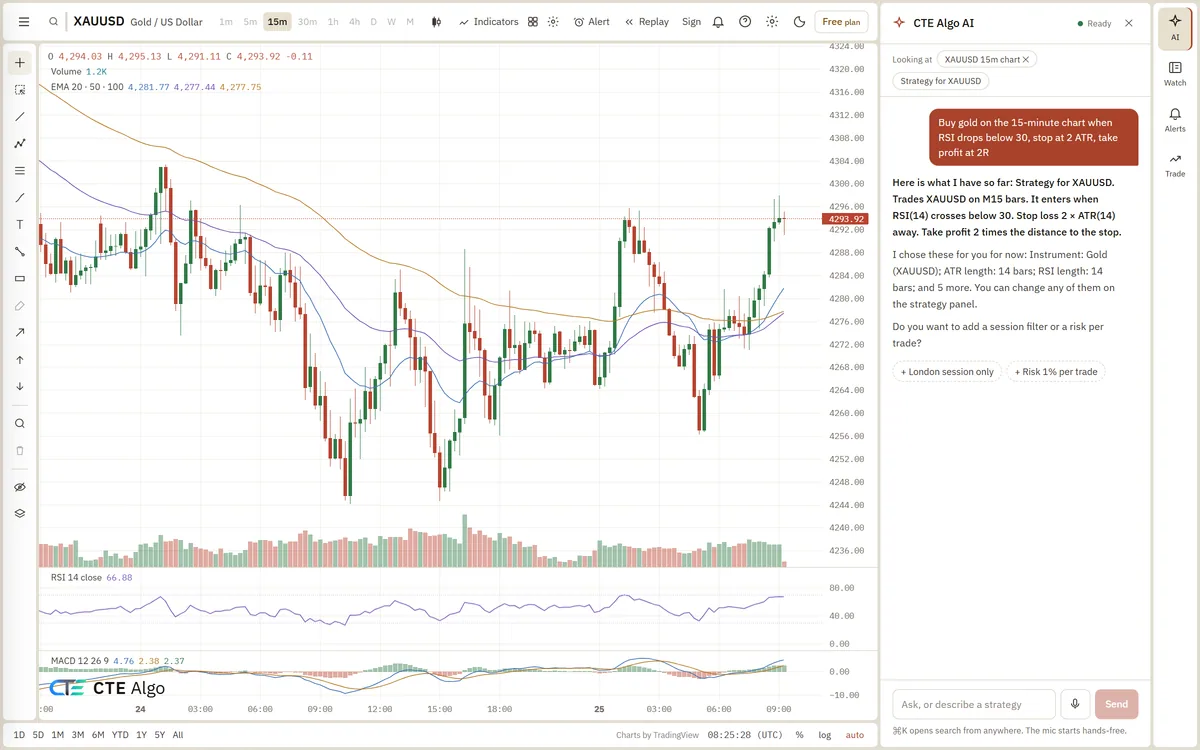
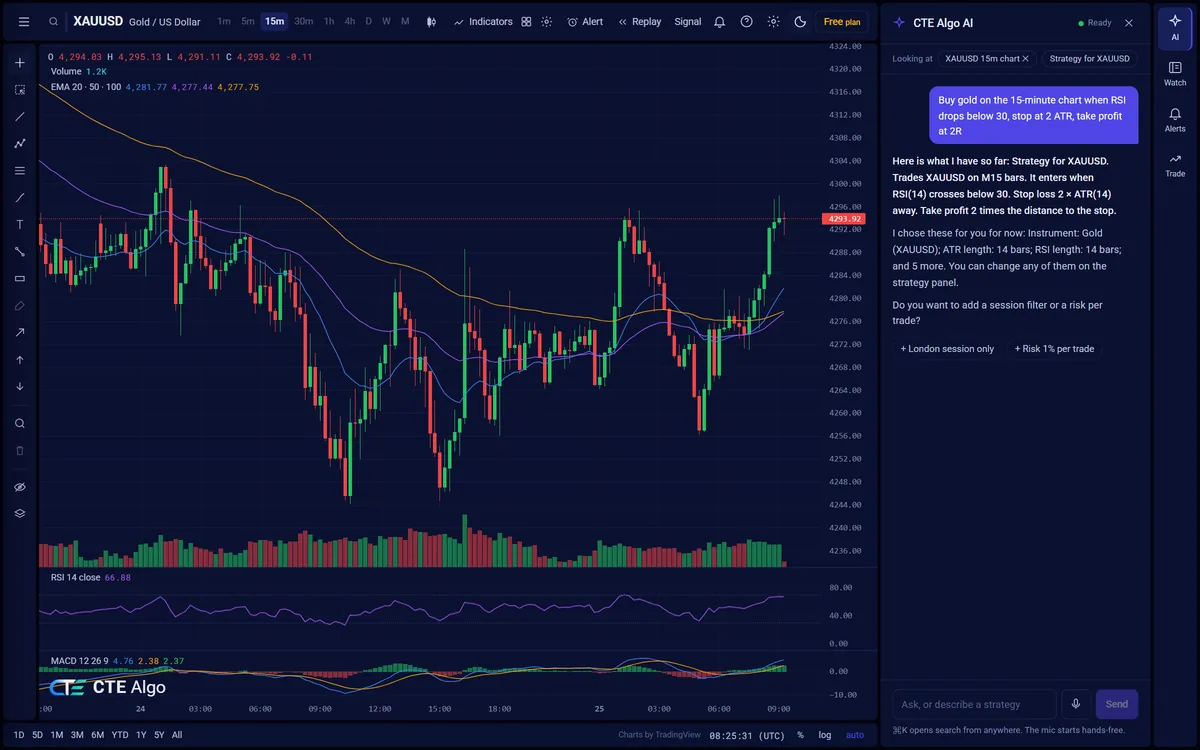
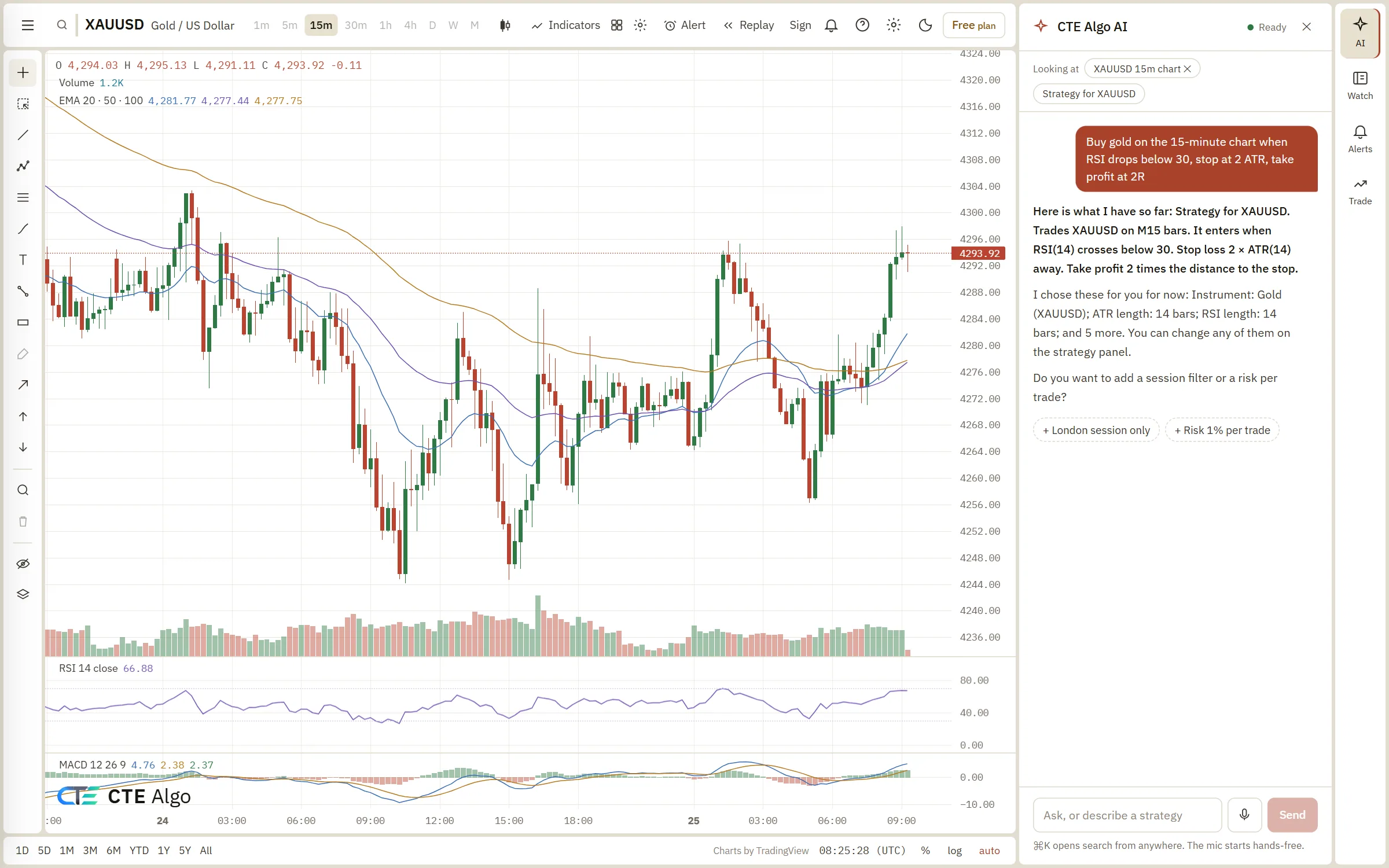
The assistant says what it understood, and what it chose for you.

Anything you leave out is chosen for you and marked as a guess you can change. The system will not hide one.

The CTE Algo workspace in the Paper theme: a 15-minute XAUUSD chart with the CTE Algo AI panel open. The assistant restates the strategy in plain words, lists the values it chose, and asks about a session filter or a risk per trade. The same workspace in the Night theme, with the CTE Algo AI panel open on the same strategy.
Development build on sample XAUUSD price data. In this capture the model's step is a recorded example, so no model was called; the readout, the assumptions and the chart are the product's own. Open the capture full size.

What you get

Six things, grouped by what you are trying to do.

Each group says whether it is built, in build or not built. We would rather tell you than let you find out.

Describe

Built

Get a strategy out of your head without learning a language first.

  • Conversational builderText or voice. A voice transcript lands in the draft and is not sent until you send it, unless you switch on hands-free.
  • Visual strategy mappingDraw demand zones and gaps on the chart. Your drawing's coordinates are authoritative and candidate rules are found by deterministic geometry. No model reads the picture.
  • Assumption ledgerEvery value you did not state is recorded, named in plain words, and one click from correction.

Verify

Built

Find out whether the strategy deserves your attention before it costs you anything.

  • Look-ahead testThe strategy is run twice over the same history with different futures. Any decision that changes was reading ahead.
  • Sensitivity and regimesEvery number is moved by ten percent, one at a time. Four periods are labelled rising, falling or ranging.
  • Execution stressSpread, slippage and dropped fills, scaled to the market so gold and a currency pair mean the same thing.

Test

Built

See what the strategy would have done, and why.

  • Backtest with costsSpread, slippage and commission are charged, at typical values for each instrument, not ignored.
  • Replay, bar by barShows only what the strategy could see at each bar, with its logic lit up as it decides.
  • Plain-language resultsAsk why it lost or what the worst trades were and get the run's own numbers back.

Keep

Built

Come back to a strategy exactly as you left it.

  • Versioned libraryVersions are immutable. Saving keeps the rules, your intent, the ledger and your corrections together.
  • ExportTake the strategy away. Exports never contain credentials.
  • A full charting workspaceDrawings, indicators, eleven chart types, Paper and Night themes.

Run

In build

Watch an approved strategy and get alerted, without handing over your account.

  • Signals on bar closeThe strategy is evaluated when a bar closes, never on a half-formed one, and alerts you through Telegram.
  • Shared feature engineAn indicator is computed once per market and timeframe and shared, so a thousand users do not mean a thousand RSIs.
  • Practice ordersPlace a manual practice order at the last closed bar's price. No real money, and no costs are charged.

Protect

Built

Rules the product keeps even when you ask it not to.

  • Risk engine with final saySize, exposure and daily loss, measured on equity. It fails closed.
  • Kill switchHalts a deployment, one user's or all of them, and records who did it and why.
  • One trace from chat to resultA single ID follows a request from your sentence to what it produced.

Not built Automated trading on a funded account. The execution core exists and has been proved against a broker demo account. The path that would trade a funded account is not built, and it will not be switched on until the rules around it are settled. It is the last thing we will do, not the next.

The tools

72 registered tools. Your rules are made from these, not from guesses.

Every tool is deterministic and causal: the same inputs give the same output, and none can read data after the moment it is asked about.

Indicators

RSI, MACD, moving averages, Bollinger, ATR, ADX, Ichimoku, Supertrend, stochastics, volume and more.

Price action

Market structure, order blocks, supply and demand zones, liquidity, support and resistance, candlestick and chart patterns.

Higher timeframes

Higher-timeframe bias and levels, read without peeking at a bar that has not closed.

Cross-asset

Correlation, comparative strength and spreads or ratios between instruments.

How we use AI

The AI reads what you mean. Ordinary code checks everything else.

When you describe a strategy, a language model (an LLM) turns your words into a structured list of what you said. It does not calculate, test or trade. Regular software does that, so the same strategy always gives the same result. We limit what the model can see and do, and we measure it. Here is the whole arrangement.

What the model is asked to do

The model's three jobs in the product
CallThe model receivesThe model returnsWhat happens next
1. ClassifyOne message and a short list of capabilities.One capability and one sentence of reasoning.A policy gate decides whether to serve it. “Should I buy gold with my savings?” is personal advice and is declined.
2. ProposeThe message and the registered tool schema, through strict, schema-locked tool use.A structured record of only what you said. Anything unstated stays empty.The compiler fills each gap from a convention and writes it to the assumption ledger. A question is asked only if the answer changes the strategy.
3. Phrase the replyWhat the turn did, for example that a strategy was proposed and two questions are open.A few sentences in plain words.The reply is text for you to read, beside the readout the compiler produced. It does not change the strategy.

On a phone, scroll the table sideways.

The boundary

Receives
  • Your sentence
  • The schema of the registered tools
  • A short system prompt, cached between calls
Never receives
  • A broker handle or an account
  • Credentials, API keys or tokens
  • A path to any of them
Never does
  • Place or change an order
  • Fill a gap without recording it
  • Approve anything on your behalf

The boundary is structural, not a prompt instruction: the model client lives in its own module with no import of a broker or a secret, and tests enforce it.

How we engineer it

  • One setting, one model

    The model is a setting, and Anthropic's Claude is the default in our code, with adaptive thinking at high effort, because a wrong reading shows up as a user approving a strategy that is not theirs. A deployment can choose another model.

  • Cached and capped

    The tool schema and system prompt run to thousands of tokens and are cached between calls. Each user has a daily and a monthly spend allowance, and whoever runs the service can also cap the API key itself.

  • Refusals are an outcome

    If the model declines, the user is told plainly. A refusal is not treated as an error or retried until it says yes.

  • Tests never call a model

    The ordinary test suite runs against a scripted client. A separate 39-case evaluation set measures the live model on demand, so a prompt change is judged on evidence.

  • A neutral boundary

    One method sits between us and any model. The evaluation set was built and run against our default model; any other model has to clear the same cases before it touches a user's strategy.

  • Voice is separate

    Voice input is transcribed in your browser, or by a speech-capable model where a deployment turns that on. It is a separate step from the AI that reads your strategy.

Where the AI layer goes next

Now

Understand

  • Sentence to strategy, with a ledger
  • Clarifying questions that matter
  • Plain-language answers about results
Next

Work the whole app

  • Questions about your own strategies and backtests
  • Start or stop a signal run, only after you confirm
  • Temporary chart overlays you can keep
Later

Live trades, later

  • Only through the gated execution rails
  • Every action returns as a confirmation card
  • The model never calls a write route itself
Not planned

Advice

  • Personal investment advice
  • Reading a picture as a signal
  • Anything that skips approval

A model is measured before it is relied on. We also build the product with AI coding assistants; see how the team works.

Where it stands

Built, in build, switched off.

A short, current list. We update it when it changes.

Built

Strategy workspace

  • Describe, understand, verify, approve
  • Backtest, replay, library, export
  • Charts, drawings, indicators
In build

Signals

  • Evaluation on bar close is built
  • Telegram alerts, first on the founder's own account
  • The shared feature engine before others join
Not built

Funded-account trading

  • Execution core built, proved on a demo account
  • A jurisdiction policy gate is built
  • The funded-account path is not built
Not scheduled

Later ideas

  • More brokers
  • A mobile app
  • More languages

Pricing is not published yet. Ask us about early access.

Bring a strategy you would like to test.

Early access is by request. Tell us what you trade and what you would like to check.